

Margins
The room for error is thin.

The relationship between competitors and routesetters is complicated because it isn’t an exact science.
As much as we would like to sit here and say that we have a grand plan on how the competition will play out and that there will be perfect separation between competitors, there are decisions we make that come down to a gamble. Our conviction that our work is dialed in, and trust in the athletes ability to perform combine to make a fair, challenging, and hopefully entertaining sporting event.
It has always been difficult to have all of these ingredients combine to make the proverbial “sauce” that goes into a successful comp. Athletes at a high level are so well rounded, that it often comes down to who performs best on a given day. Athletes like Janja and Sorato are hailed because of their high levels of consistency, which few are able to achieve. Many competitors on the World Climbing stage may make it into finals once or twice in a year, and fail to execute to that level again across multiple events or seasons.
Routesetting is the other half of the coin. There are rounds where certain athletes can better find their flow because the boulders are found more within their strengths, and rounds where they might miss a final because the set of boulders weren’t in their roundhouse. Variety and challenge create separation, and we are lucky to be part of a sport where the ways the athletes can be pushed are constantly evolving.
The rising ability of athletes across all levels has made the margins of error for routesetters thinner. Separation for athletes on the top end sometimes is not coming down to a single boulder, but a single move.
Two risks I took at recent events played out very different versions of this routesetter/athlete scenario.
Sometimes it doesn’t pay off…
I had the privilege of joining Nick and the crew at Method in April for MUG. This comp has become one of the premier independent events in the country, attracting talent from all over the states, as well as internationally.
Annabelle, Ivan, Ryan, and I worked on the women’s final round, and felt pretty confident in its difficulty level throughout the week. It had a challenging slab, tricky lache, and two power boulders, which fell into the “rock climbing is cool again, coordination is out” camp. This competition featured a changeover, which meant that we would mark and strip the finals boulders early in the week, and put them back up on Saturday night after the citizens round concluded.
I generally prefer this setting format because having access to change the finals boulders during the week can result in unnecessary changes or spending time tweaking for the sake of tweaking. Only having an hour to put the boulders back up on comp day, followed by an hour of game-time tweaking, usually leads to more critical decision making.
The main concern going into finals was the women’s performance during the qualifier round.
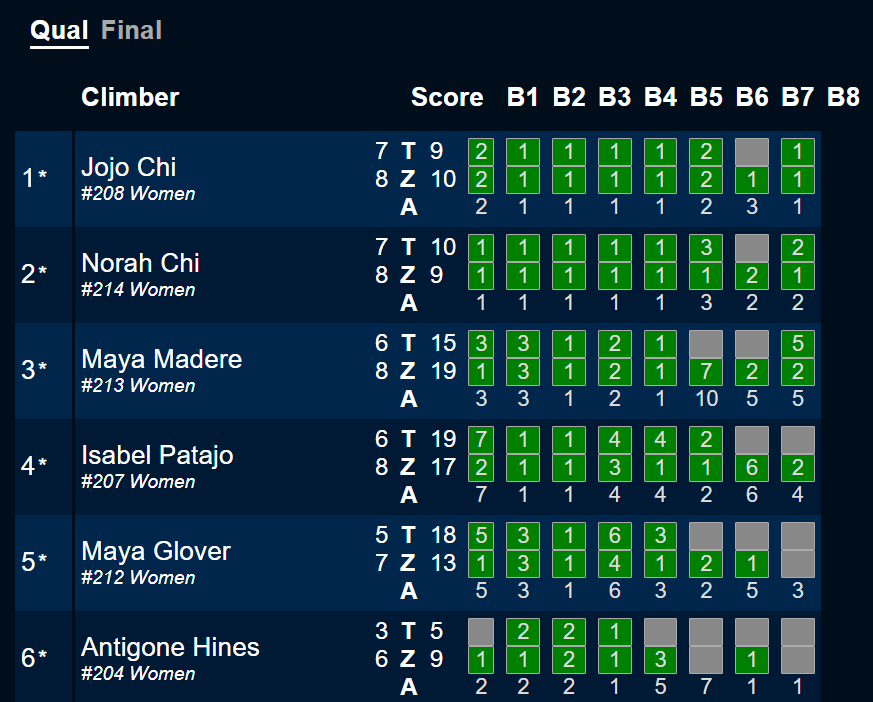
While there wasn’t a huge disparity in what boulders got topped, Norah and Jojo did the boulders in significantly less attempts. They almost flashed all of them. This means that they were coming into finals less fatigued, and that maybe the qualifier boulders were too easy for the top end of the field.
We had a discussion prior to changeover and agreed that we could make a boulder or two easier to zone, and a boulder or two harder to top to separate Norah and Jojo.
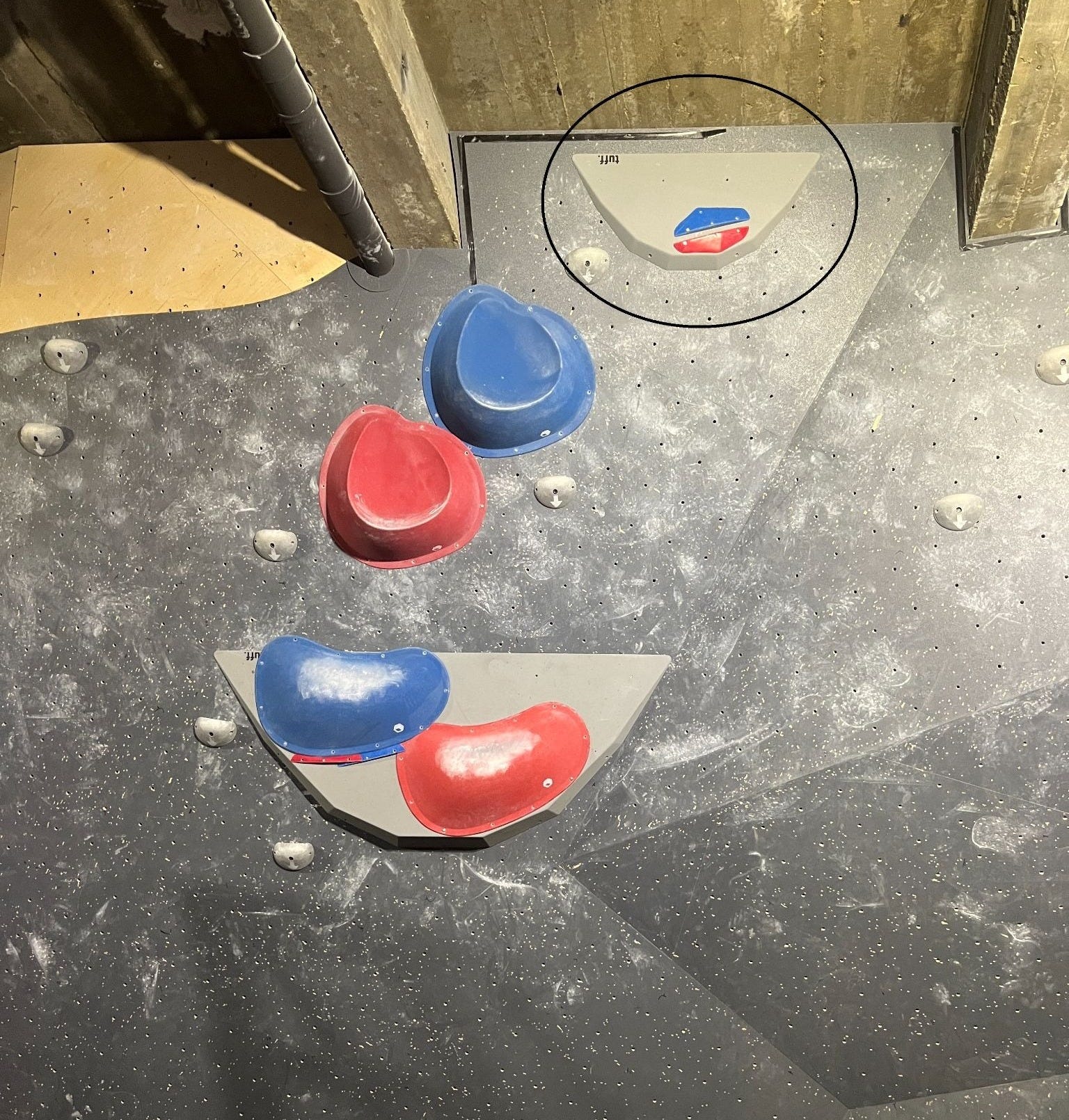
This is my boulder prior to tweaking. We decided to move the circled volume up and right ~6ish inches to make the last move more risky. If you were taller, it was possible to gain the finish hold while keeping your foot on the start in this iteration. In a perfect world, this would’ve been the tweak to separate Norah and Jojo, but this didn’t go according to plan.
Unfortunately this turned the boulder into a no-topper. Both Norah and Jojo had their hands on the finish hold, but couldn’t control it. I think this was ultimately because the hold was turned slightly too aggressively.
Here are videos of their best attempts:
In hindsight, if the volume moved straight up from where it was there wouldn’t have been as much shoulder engagement required for the last move. The volume also could’ve stayed where we moved it if the crimp turned more downpull. This would’ve made it easier to control while cutting feet. I think there is a reality where if we just left this boulder how it was it might’ve gotten separation, the last move was risky in its original form, and I think the time constraint combined with us second guessing ourselves led to a less than ideal scenario.
I wasn’t happy about the results from this one because I pushed for these tweaks to happen and the team trusted my judgement. I had confidence one of them would do this boulder, as I set a similar move to this on a boulder at Vital’s comp back in October that Norah did easily, and Jojo was unable to do it.
The other side of this is that the boulder was not boring to watch, and showed progression throughout the running order of climbers, with Jojo coming out last and ultimately coming the closest. I wouldn’t sum this up to a total failure but it feels worse having an outcome like this at a comp you’re invited to set for.
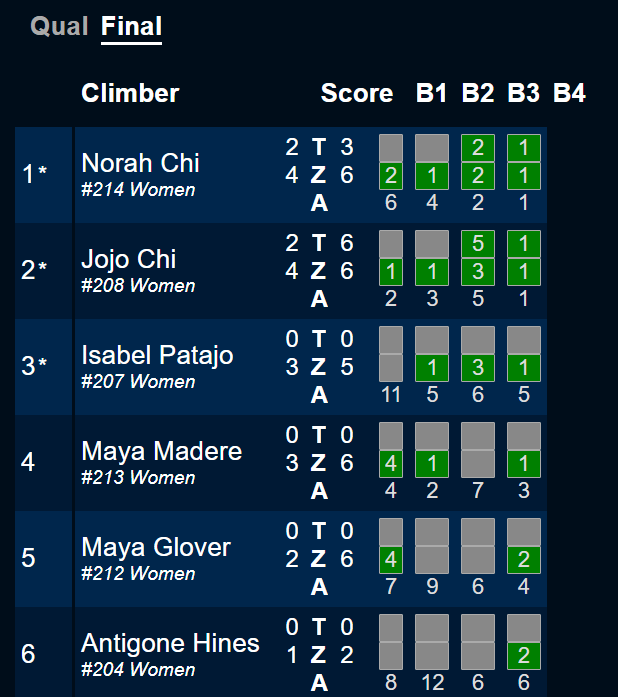
Here are the final results for the comp, a hard round for both men and women with the winners in each getting 2 tops. Norah and Jojo were separated on attempts:
Sometimes it does pay off…
Two weeks later I found myself in a similar scenario during our Tough Love comp in Philly.
This time I was working on the women’s round with Vini, Chris, and Katherine and we had an almost completely different field of competitors. We did have the luxury of not having to do changeover at this comp, so the finals were in a tarped off area and we were able to work on them for an extended period of time before finals.
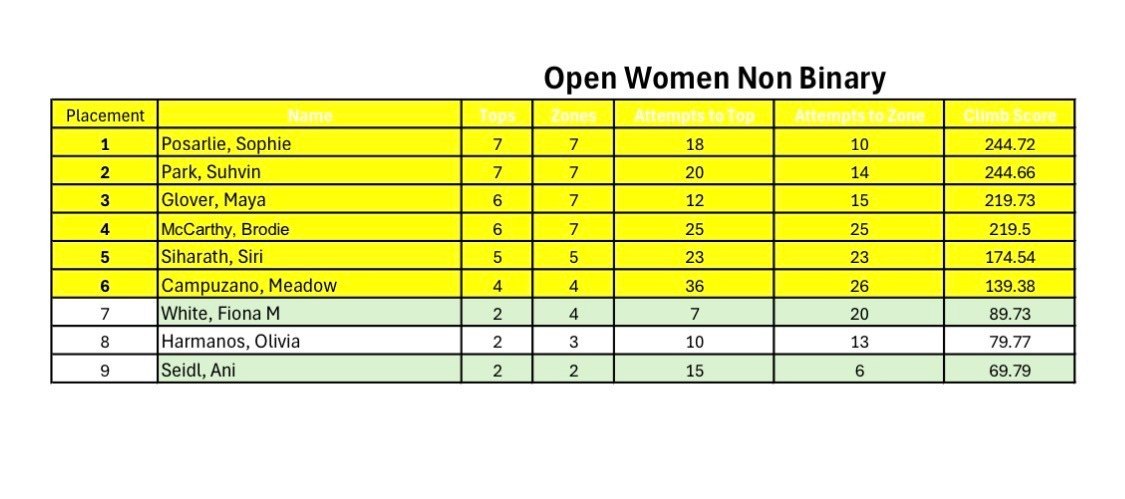
The first thing to note is that there is not as much of a disparity in tops and zones as the Method comp, but each athlete took a high amount of attempts on each boulder. This means they will be more tired going into finals. The second is that there was a highly physical “rock climbing” boulder in the qualifier round that we expected to get topped by the women, and it did not. This was a good indicator for how they would perform on my finals boulder.
With these things in mind, we decided to make my finals boulder easier.
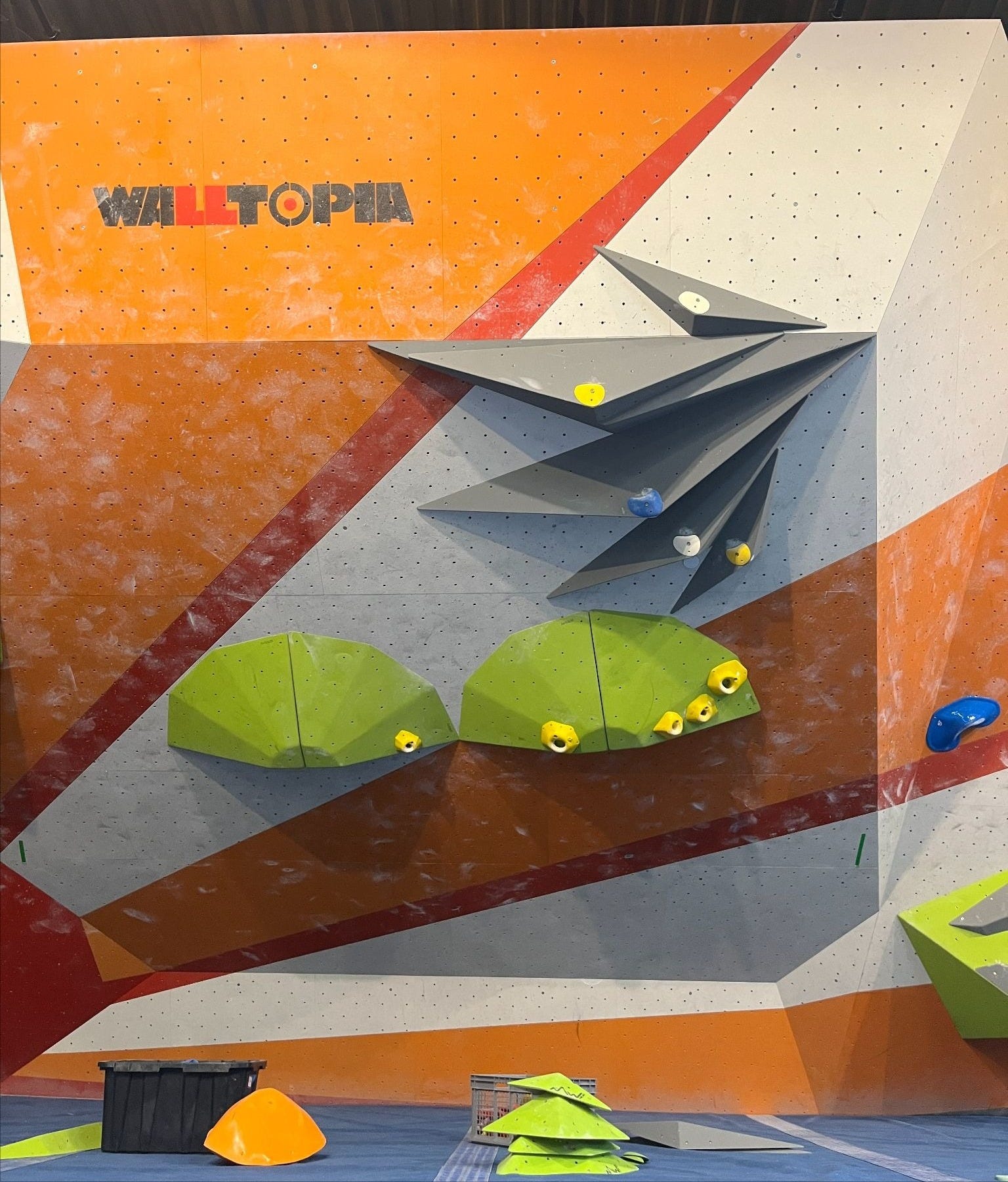
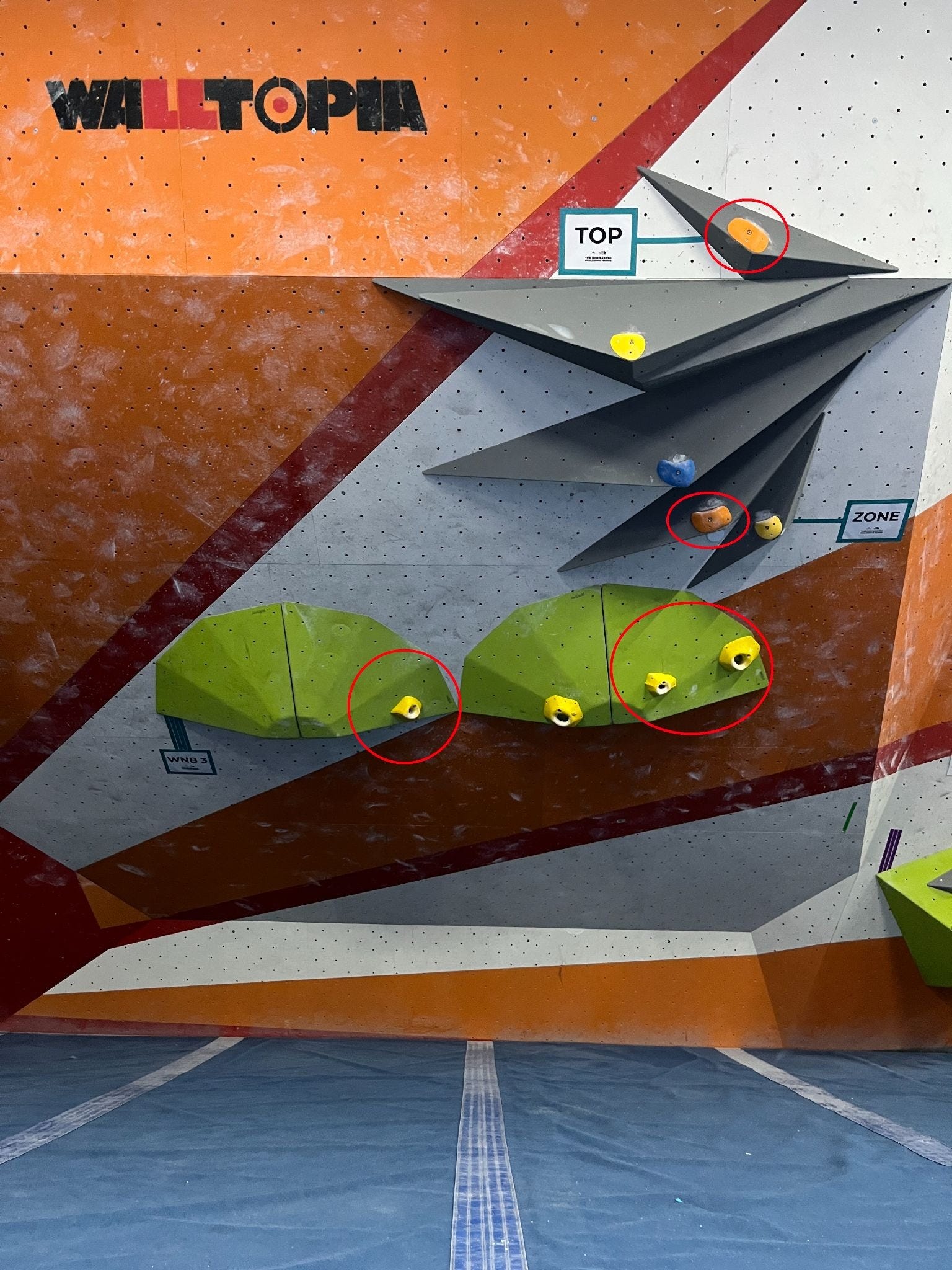
Here’s the laundry list:
The bottom pockets were rearranged to make the first move easier, and the 360 campus more intuitive, I don’t think it drastically changed the difficulty up or down besides making the first move more accessible (shoutout Henry).
The crimp after zone was changed to be more positive. This made the beta through this section a bit more open ended which gave competitors more room for error.
The final crimp was changed as this added a potential fall point after the 2nd crux that was unnecessary. We love a hold you can do a finish celly on (Shoutout Altana).
Did our gamble pay off? This time it did.
The boulder had 4 zones and two tops, with one of the tops being a flash. This was initially thought to be the hardest boulder in the women’s round (it ended up being the slab), so these numbers are what we were aiming for.
In reality, these were rather minor tweaks that didn’t change any of the sequencing of the climb or spacing of the holds. Replacing holds for better options is the safest way to approach tweaking in this format. As I mentioned before, improving the crimps made a high foot beta option easier, which I wasn’t crazy about, but it ended up being best for the competition
Maya’s near miss at the top, followed by her successful attempt:
Sophie’s flash:
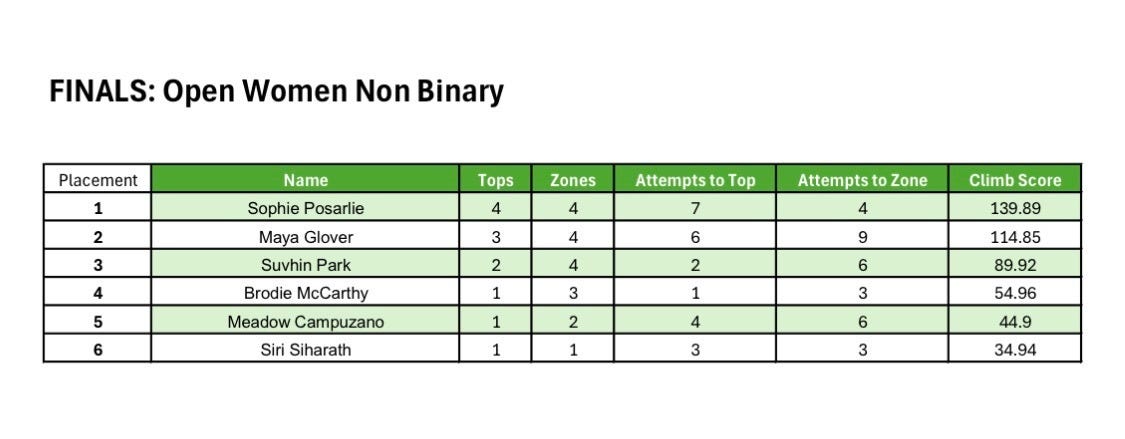
The final results of this comp were some of the best we’ve ever had, with all competitors being separated through zones and tops without having to factor in attempts. This doesn’t happen often, so it feels like a perfect storm.
Are we Gambling?
The short answer is yes. Every time we are trying to maximize the odds of success before the competitors step out onto the mats. Through years of experience I’ve gotten better at gauging what risks to take. However, the reality lies in the fact that you could take the same set of competitors and put them on the same set of boulders a different day of the week and the results could be completely different.
There are so many factors at play, and that’s what makes the sport exciting. One of the most recent World Climbing men’s finals in Bern had everyone on the edge of their seat because competitors were defying expectations for podium on every boulder. This is not because the routesetters had a grand plan to make this happen. They took their years of experience to calculate the risk, and the athletes made their own luck.
Athletes remember the struggle, spectators remember the sports action, and routesetters ruminate over mixed results.

Tough Love boulder looking cute!